
Network master clock
PTPMaster — one time source for your whole network
GNSS-disciplined PTP IEEE 1588 Grandmaster for local timing infrastructure. It distributes precise time over an Ethernet network using an IEEE 1588 hardware timer aligned to the GNSS receiver PPS. It supports the SMPTE ST 2059-2 and AES67 profiles, exposes an integrated web dashboard and can also operate as a Stratum-1 NTP server.
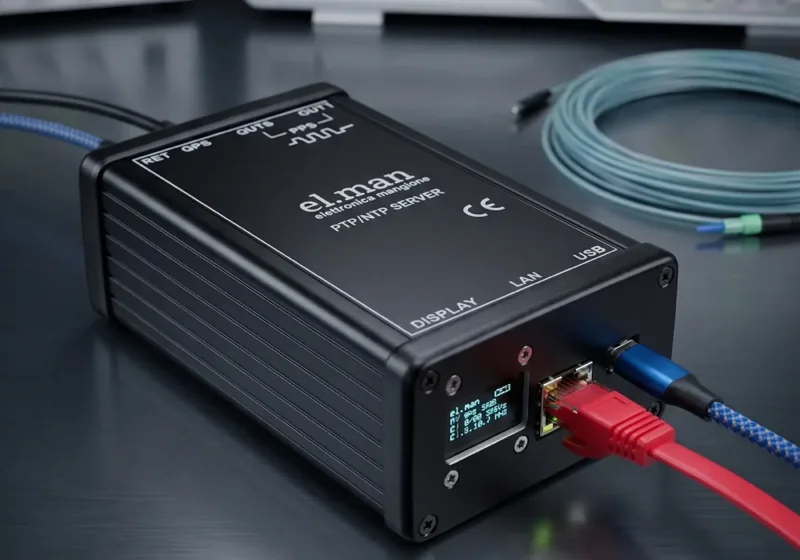
PTPMaster – Front display view
Features
PTPMaster – PTP Grandmaster for local timing networks
- PTP IEEE 1588v2 Grandmaster
- GNSS discipline with hardware PPS
- Local Stratum-1 NTP server
- Operating modes: PTP-only, NTP-only, PTP+NTP
- Two hardware PPS outputs
- Real-time integrated web dashboard
- IEEE 1588 hardware timer (not software emulation)
- OLED display 128×64 px
- OTA firmware update via Ethernet
- Persistent configuration (EEPROM)
PTPMaster is a time source for Ethernet networks, designed for applications where the time reference cannot be left to the local clocks of the endpoints. The device uses a multi-constellation GNSS receiver as its absolute reference and disciplines an IEEE 1588 hardware timer to operate as a PTP Grandmaster on the network. In parallel, when required, it can also expose a local NTP service.
For an engineer this means a single GPS-locked time source for the whole network: no drift between endpoints, SMPTE ST 2059-2 and AES67 profiles ready to go. Elettronica Mangione has synchronized TV studios since 1984.
The system timebase is not purely software. The firmware uses the ENET 1588 hardware timer as the actual timebase. GNSS provides two distinct contributions: an absolute timestamp through the navigation messages and phase alignment through the PPS pulse. The device does not simply "read GPS time": it disciplines the hardware timer that is then used for PTP messages, for the local PPS and for the status services.
Supported protocols and profiles
- IEEE 1588v2: PTP Grandmaster Layer 3, E2E mechanism
- SMPTE ST 2059-2: Profile for broadcast infrastructure
- AES67: Profile for audio-over-IP networks
- NTP Stratum-1: For non-PTP hosts or mixed networks
- Custom profile: Configurable for specific scenarios
Use cases
- Broadcast: Infrastructure with the SMPTE ST 2059-2 profile
- Audio-over-IP: Networks with AES67 devices
- Laboratories: Test, verification and measurement
- Embedded systems: Local reference source
- Isolated LANs: Segmented technical installations
Integrated web dashboard
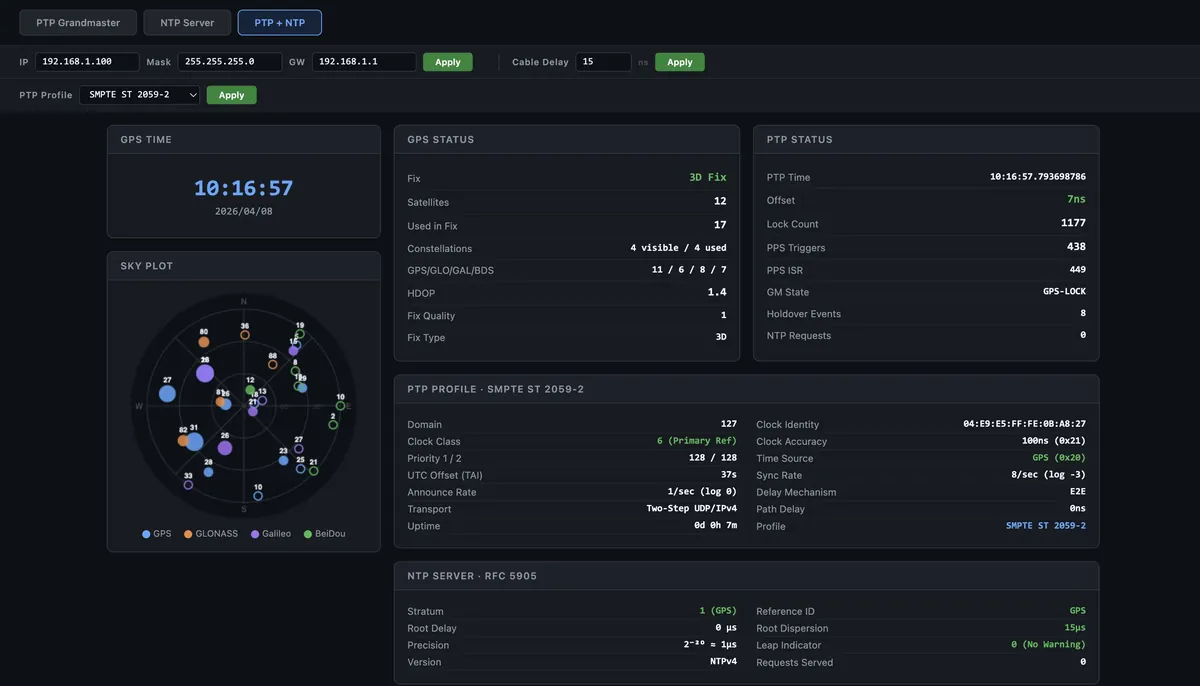
The web dashboard shows in real time the current time, GNSS fix status, number of visible and used satellites, distribution per constellation, satellite sky plot, PTP offset, path delay, lock count, Grandmaster state (GPS-LOCK or HOLDOVER), active PTP profile and NTP parameters. For an engineer this means being able to tell apart quickly a GNSS reference problem, a PPS acquisition problem, a servo convergence problem or a client-side network problem.
Specifications
PTPMaster
Hardware Platform
- Microcontroller: NXP i.MX RT1062, ARM Cortex-M7 600 MHz
- IEEE 1588 timer: ENET 1588 hardware, 25 MHz clock
- Display: OLED SSD1306, 128×64 px, I2C
Network Interface
- Ethernet RJ45, 10/100 Mbps
- IEEE 1588 hardware timestamping
- Default IP: 192.168.1.100 (configurable via EEPROM)
- mDNS support
GNSS Receiver
- Model: u-blox NEO-M9N
- Constellations: GPS, GLONASS, Galileo, BeiDou
- Time pulse: 1 PPS (stationary mode)
- PPS jitter: < 15 ns in stationary mode
Protocols
- IEEE 1588v2 PTP Grandmaster (Layer 3, E2E delay mechanism)
- NTP Stratum-1 (RFC 5905)
- SMPTE ST 2059-2
- AES67
- Configurable custom PTP profile
I/O Interfaces
- RJ45 Ethernet
- USB (power and programming)
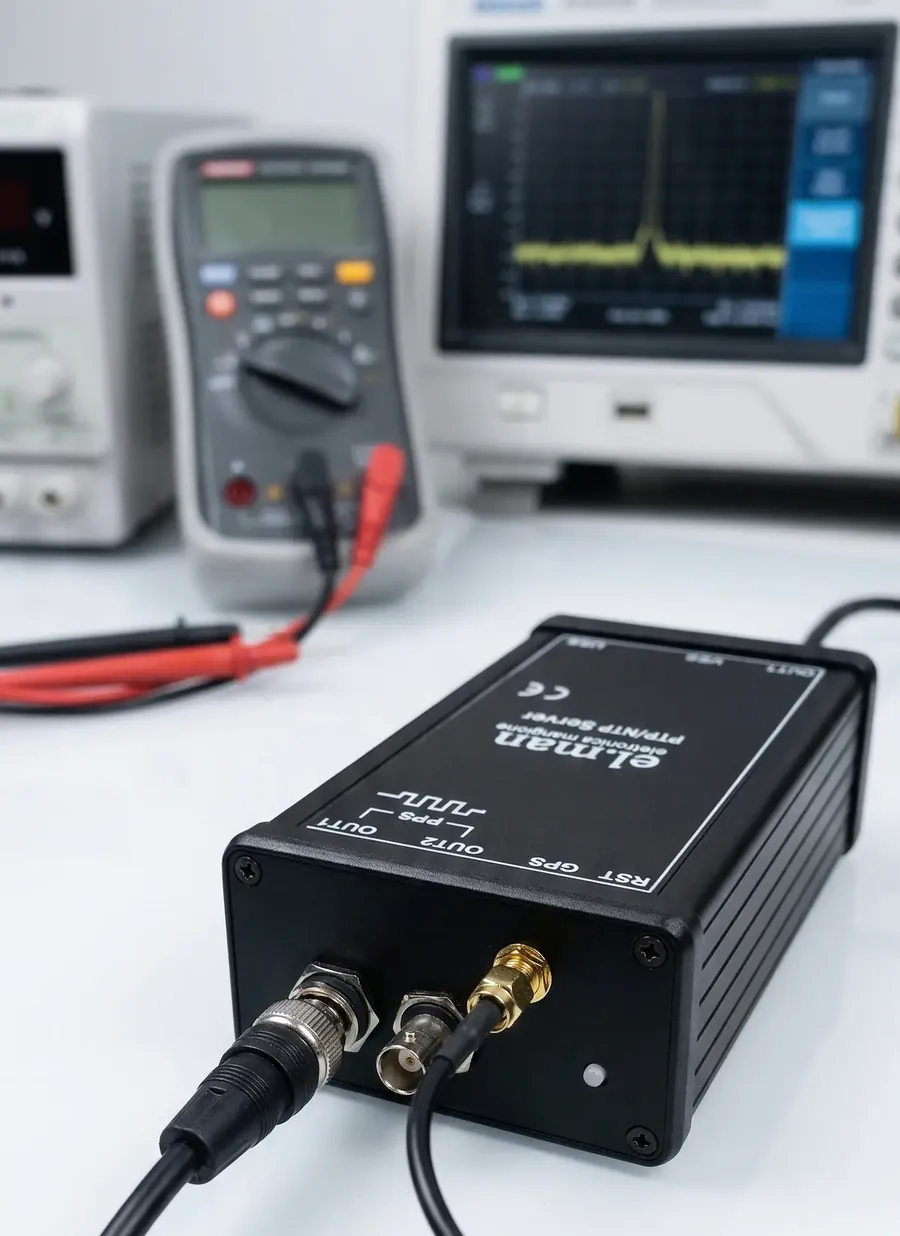
- SMA (GNSS antenna connector)
- PPS OUT 1 – local PPS output (dedicated IEEE 1588 pin)
- PPS OUT 2 – local PPS output
Power supply
- 5 VDC (via USB or VIN pin)
- Consumption: ~200 mA
Firmware Update
- OTA via Ethernet (Intel HEX)
- Optional: AES-128-CBC encryption
Operating parameters
- Temperature: 0° to 55°
- Humidity: up to 80% (no condensation)
Compliance
- ROHS, CE
Frequently asked questions
Frequently Asked Questions (FAQ)
If your question is not here, send it to us directly: the people who design the product will answer.
What is the PTPMaster?
The PTPMaster is a GNSS-disciplined PTP IEEE 1588 Grandmaster that distributes a precise time reference over an Ethernet network using a hardware timer aligned to the GNSS receiver PPS.
Can the PTPMaster also work as an NTP server?
Yes. It can operate in PTP-only, NTP-only or PTP+NTP mode and act as a local Stratum-1 NTP server, useful for hosts that do not speak PTP in mixed networks.
Which profiles and standards does it support?
It supports the SMPTE ST 2059-2 and AES67 profiles, with two hardware PPS outputs and a hardware IEEE 1588v2 timer, not software emulation. A configurable custom PTP profile is also available for specific scenarios.
How is it configured and updated?
Through an integrated real-time web dashboard. The firmware updates OTA over Ethernet in Intel HEX format, with optional AES-128-CBC encryption, and the configuration is stored persistently in EEPROM.
What is the difference between a hardware timer and software emulation?
The firmware uses the ENET 1588 hardware timer as the actual timebase, not a software counter. GNSS provides two distinct contributions: an absolute timestamp from the navigation messages and phase alignment through the PPS pulse. The disciplined timer is then used for PTP messages, for the local PPS and for the status services.
Related Products
Complete the timing chain
Timecode distribution
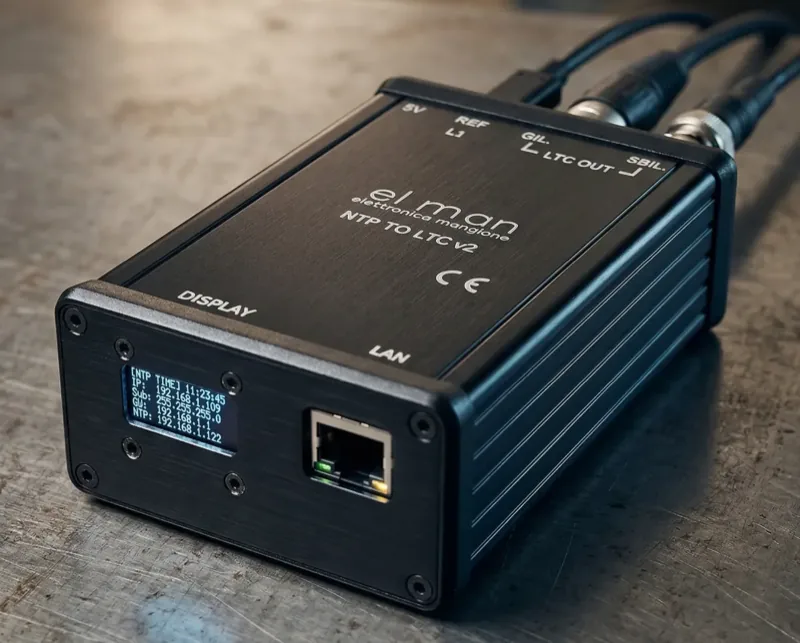
NTP/LTC Converter
NTP → LTC conversion with millisecond precision. It generates LTC timecode for broadcast studios on balanced XLR and BNC outputs.
Learn more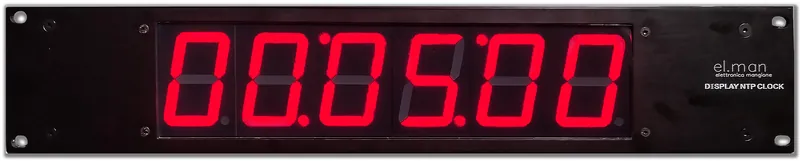
Visibility in the studio
Tv Studio Clocks
NTP-synchronized clocks for television studios. High-visibility LED displays with network synchronization.
Learn more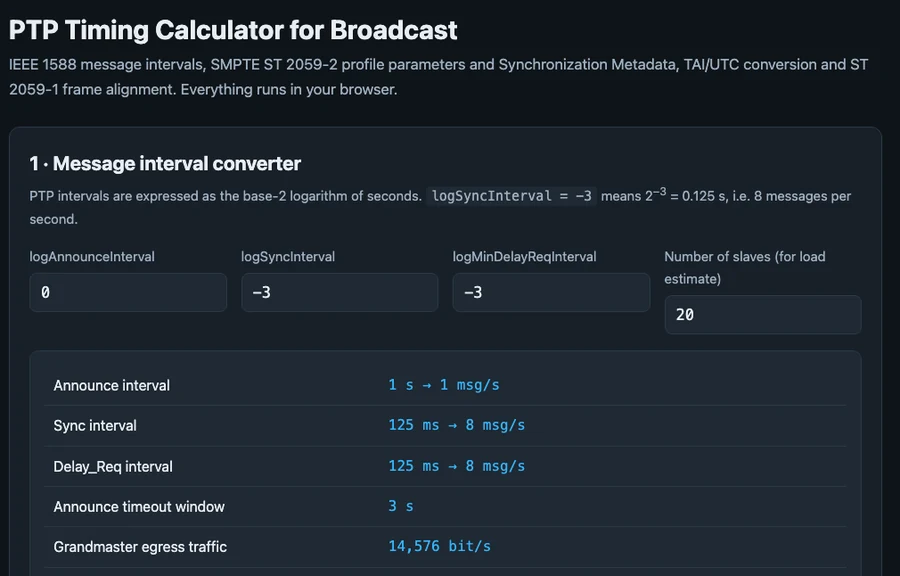
Free web tool
PTP Timing Calculator
Work out IEEE 1588 message intervals, check SMPTE ST 2059-2 profile parameters, convert PTP time to UTC and compute ST 2059-1 frame alignment. No registration.
Open the calculatorLet's talk
Tell us about your timing network.
We help you work out whether you need a PTP grandmaster, an NTP server or both, before you ask for a quote.