
Timecode distribution
NTP/LTC Converter — legacy broadcast talks to your network
Professional NTP-to-LTC converter with millisecond precision. It synchronizes via LAN from an NTP reference and generates LTC timecode on balanced and unbalanced outputs for critical broadcast applications.
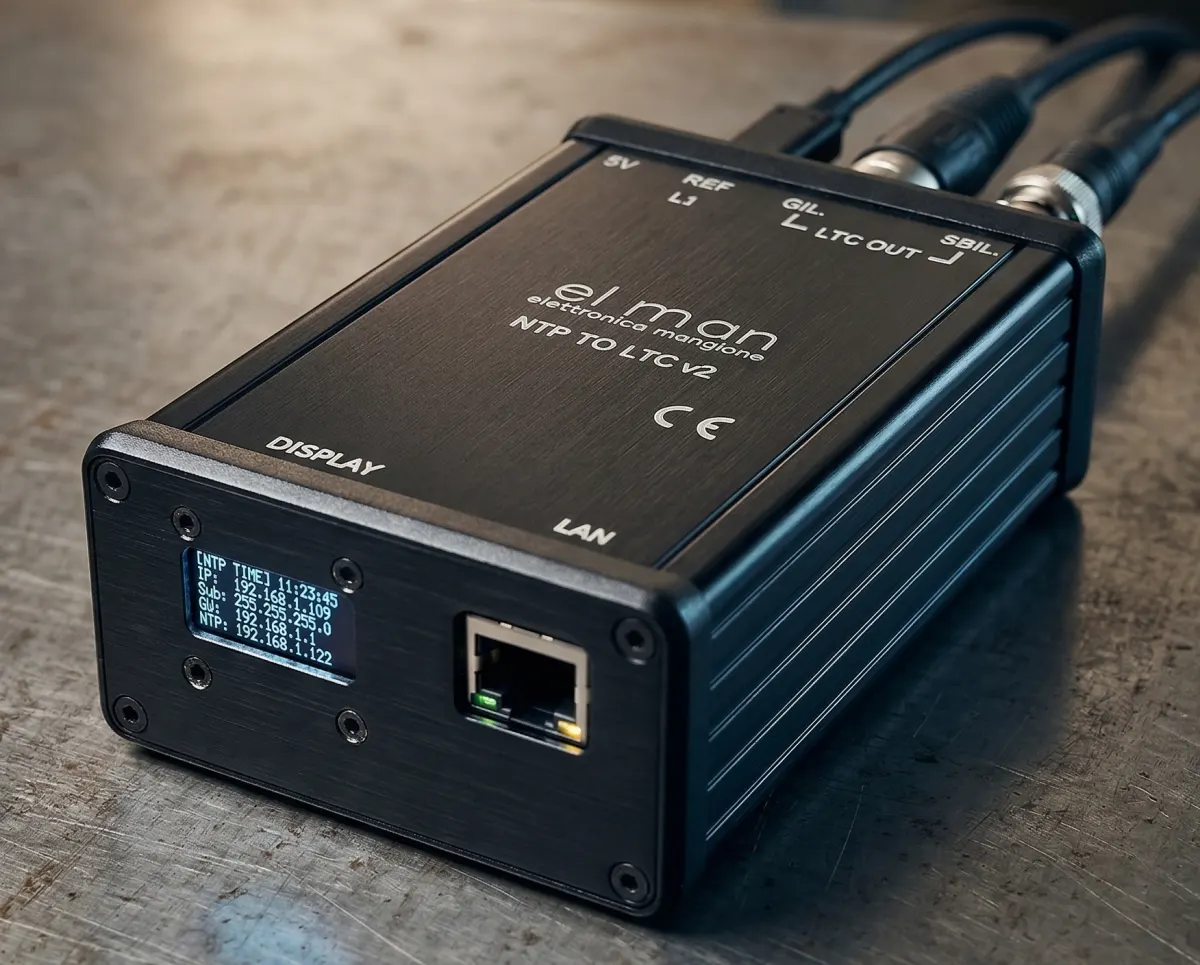
Ntp to LTC converter
Features
Professional NTP/LTC Converter
- Millisecond synchronization precision
- NTP synchronization from LAN network
- NTP → LTC conversion from LAN input to balanced and unbalanced LTC outputs
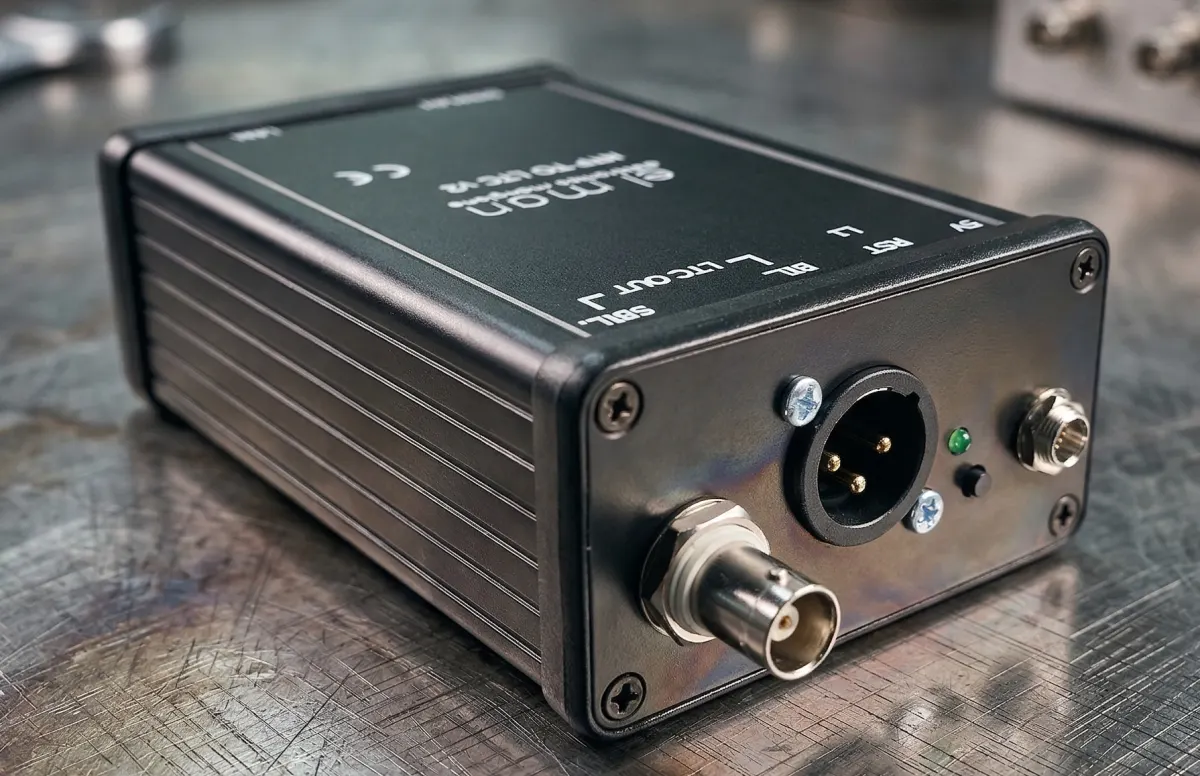
- Balanced XLR and unbalanced BNC LTC outputs
- Complete web interface configuration
- OLED display for status and configuration
- Reset button to restore the default IP address
- 5V power supply with external adapter
- Front display to show addresses and last NTP synchronization
The professional NTP/LTC converter is designed to synchronize from an NTP reference available on the LAN network and generate LTC timecode with millisecond precision. It is ideal for broadcast and audiovisual installations that require a reliable NTP to LTC conversion chain.
The real problem: legacy LTC gear doesn't talk to modern NTP networks. This converter bridges them, with balanced XLR and BNC outputs compatible with any studio setup. Elettronica Mangione has synchronized TV studios since 1984.
Signal Interfaces
- LAN / NTP input: Synchronization from an NTP reference over Ethernet
- LTC balanced output: XLR male 3 pin
- LTC unbalanced output: BNC connector
- GPIO: Programmable inputs and outputs
Main Features
- NTP Synchronization: Receives timing from an NTP reference via LAN
- Timecode Generator: Creates LTC from the NTP reference
- Converter: One-way NTP→LTC conversion
- GPIO: Interfaces for custom applications
Specifications
NTP LTC Converter
Connectors
- Ethernet RJ45
- 5 VDC input
- XLR male 3 pin: LTC balanced output
- BNC: LTC unbalanced output
- GPIO: programmable inputs/outputs
- LAN input for NTP synchronization
Power supply
- 5VDC
- Power consumption < 5 W
Operating parameters
- Temperature: 0° to 55°
- Humidity: up to 80% (no condensation)
Physical Characteristics
- Chassis in Black Metal
- Dimensions 8 l x 4,5 h x 12,6 d cm (3,15 l x 1,77 x 4,96 inches)
- Weight: 0,5 Kg (1,10 pounds)
Hardware Platform
- Processor: ESP32 dual core 240MHz
- Timecode Encoder: Professional ICS2008B
- Display: OLED 128×32 pixel
- GPIO Expander: MCP23S17 SPI
- Timer Precision: ±1 µs NTSC, ±2 µs PAL
Timecode Generation
- PAL: 25 fps (40.000 µs per frame)
- NTSC: 29.97 fps drop-frame (≈33.333 µs per frame)
- PLL Discipline for smooth synchronization
- Continuous output even during NTP sync
- SMPTE drop-frame rules support
Network Configuration
- Automatic DHCP with static IP fallback
- Default IP: 192.168.1.100/24
- mDNS support: http://ntpltc.local
- Complete web interface
- OTA firmware updates
Compliance
- ROHS, CE
Frequently asked questions
Frequently Asked Questions (FAQ)
If your question is not here, send it to us directly: the people who design the product will answer.
What does an NTP/LTC converter do?
It receives a network time reference (NTP) and turns it into an analogue LTC timecode signal (Linear Timecode), essential for synchronizing legacy or specialised broadcast equipment with modern network infrastructure. It synchronizes over LAN and generates LTC with millisecond precision for critical broadcast applications.
What is the precision of the generated signal?
The converter guarantees millisecond precision, essential to keep video and audio systems perfectly in sync in complex television productions. The hardware timer works with a precision of ±1 µs in NTSC and ±2 µs in PAL.
Which types of LTC outputs are supported?
The device provides both balanced outputs on a 3-pin male XLR connector (the professional standard) and unbalanced outputs on a BNC connector, guaranteeing maximum compatibility with any studio setup.
How is it configured?
It is configured through a complete web interface, also reachable over mDNS at http://ntpltc.local. It has an OLED display for status and configuration and a reset button to restore the default IP address. The network supports automatic DHCP with static IP fallback.
How is it powered?
It is powered at 5V through an external adapter, with a consumption below 5 W.
Related Products
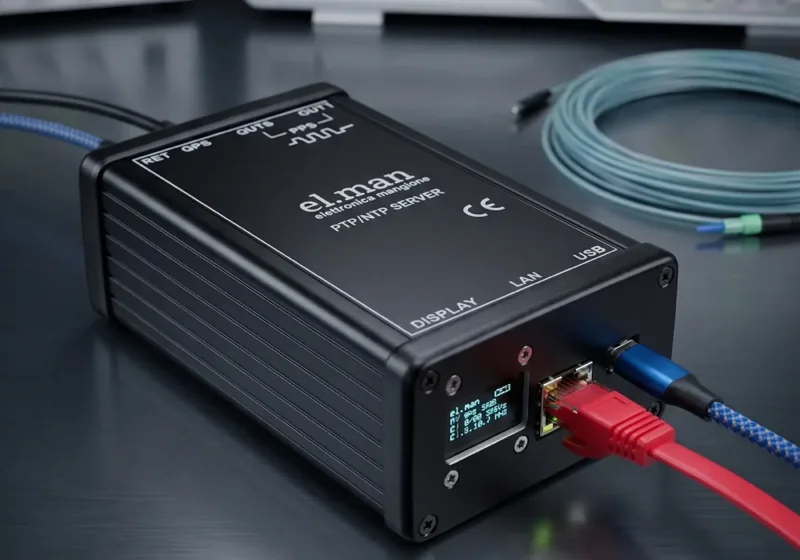
If you need one time source for the whole network
Let's talk
Tell us about your timing chain.
We help you work out whether the NTP/LTC converter is the right answer before you ask for a quote.